Evolutionary plasticity of bacterial surface layer protein exoskeletons
Anna Barwinska-Sendra, Paula S. Salgado & Kacper M. Sendra
Nature Communications, 2026
Abstract
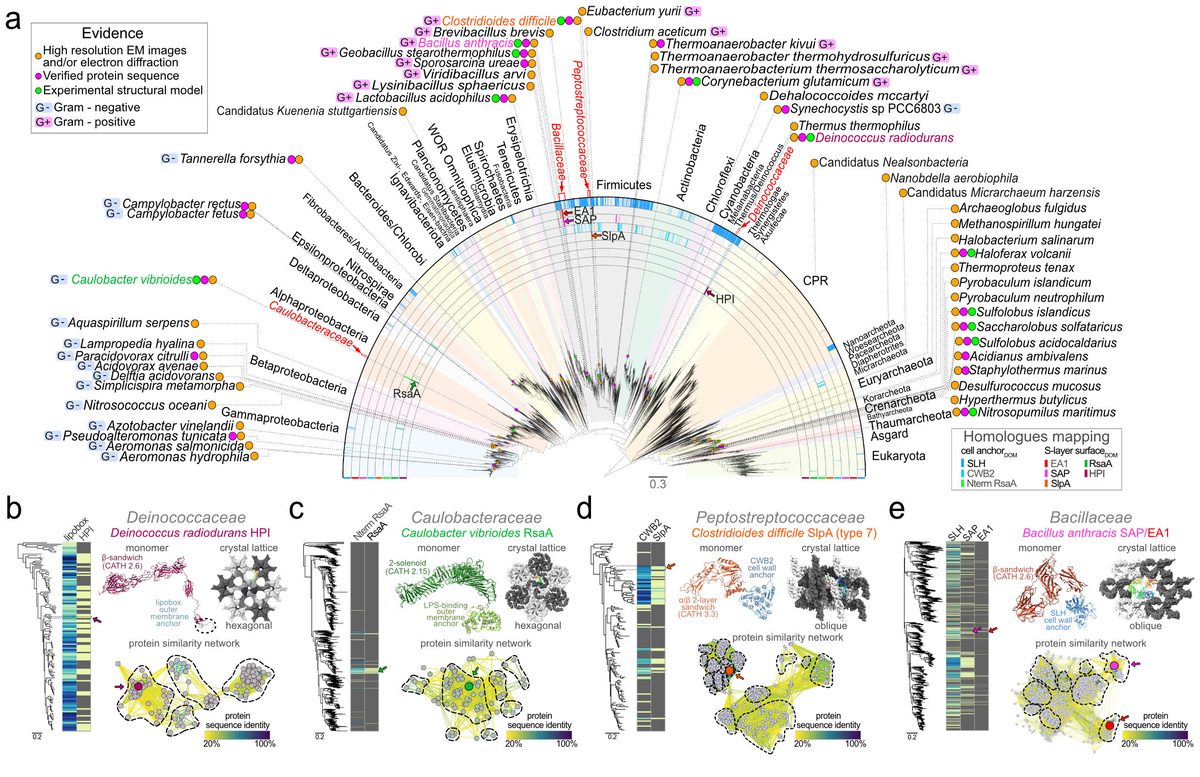
All cellular life possesses environmental interfaces like cell membranes or cell walls, yet the compositional complexity of these major cell components limits structural and evolutionary studies. Prokaryotic surface layer (S-layer) exoskeletons, with their homopolymer paracrystalline architecture, offer a more tractable model of an environmental interface. However, extreme sequence diversity and heterogeneous multidomain organisation of S-layer proteins confound conventional evolutionary analyses. Here, by combining phylogenomics with structural modelling, we show that extensive sequence divergence, modular evolution and lateral gene transfer drive lineage-specific S-layer diversification across both monoderm (Bacillaceae, Peptostreptococcaceae) and diderm (Caulobacteraceae, Deinococcaceae) bacteria. Focusing on the Gram-positive order Peptostreptococcales, including environmental isolates and clinical pathogens, we uncover multiple S-layer architectures conferring divergent physiological properties. Molecular microbiology reveals that among close relatives utilising the same exoskeleton type, only pathogens display resistance to the antimicrobial immune effectors LL-37 and lysozyme. Furthermore, by experimentally determining two S-layer structures, we unravel how mechanisms including (intra)domain gains and losses generate hyper-diversity of homologous S-layers among clinical isolates of the pathogen Clostridioides difficile. Our findings establish the S-layer as a paradigm of molecular modularity and evolutionary plasticity. Specifically, evolution of a single structural protein enables rapid cell-surface reconfiguration and contributes to immune evasion in bacterial pathogens.